History of the Cyclotron
The cyclotron went from a sketch to the central instrument of 1930s nuclear physics in under a decade, hit a wall relativity built, escaped it twice, and ended up in hospital basements around the world. Dates and figures below follow the standard histories cited at the end; where a primary document is in this site's library, the text links to it. The figure plots the machines described on this page, beam energy against year of first beam, on the logarithmic scale that Livingston's famous chart made standard, with the amateur census drawn on the same axes because the two stories share a starting point and nothing else. The amateur story is told as a parallel track at the end of the page, after the professional one.
How to read the chart. It is an energy-scale comparison, not a table of like quantities: light-ion machines are plotted at beam kinetic energy, the heavy-ion RIKEN SRC at energy per nucleon, and the two MSU machines at their bending-limit K value (the proton energy the magnet could hold, in MeV); the two medical entries are machine classes at a nominal year, not single machines. The full data, with each convention stated, is in the table under the chart.
Chart data (table)
| Machine | First beam | Energy | Type | Note |
|---|---|---|---|---|
| Lawrence–Livingston 4-inch | 1931 | 80 keV (H₂⁺) | Classical (fixed-frequency) | The first working cyclotron — under 1 kV on the electrode, eighty-fold voltage multiplication. |
| Berkeley 11-inch | 1932 | 1.22 MeV (protons) | Classical (fixed-frequency) | First artificial beam past a million volts, January 1932. |
| Berkeley 27-inch | 1933 | 6.3 MeV (deuterons, by 1936) | Classical (fixed-frequency) | Built on the 80-ton Federal Telegraph magnet in 1933; 20 µA of 6.3 MeV deuterons by 1936 (Craddock 2010). |
| Berkeley 37-inch | 1937 | 8.5 MeV (deuterons, 1938) | Classical (fixed-frequency) | The 27-inch re-poled to 37 inches in 1937; 100 µA at 8.5 MeV by 1938 (Craddock 2010). |
| Crocker 60-inch | 1939 | 16 MeV (deuterons) | Classical (fixed-frequency) | Medical and isotope machine; produced the first transuranic elements. |
| Berkeley 184-inch | 1946 | 190 MeV (deuterons) | Synchrocyclotron | First full-scale synchrocyclotron, 1 November 1946 (the principle had been tested on the 37-inch earlier that year); later 380 MeV alphas and 350 MeV protons. |
| Delft | 1958 | 12.7 MeV (protons) | Isochronous (AVF) | First sector-focused (isochronous) cyclotron — four sectors, 86 cm poles. |
| TRIUMF 520 MeV | 1974 | 520 MeV | Isochronous (AVF) | Six-sector H⁻ machine 18 m across, described by TRIUMF as the world’s largest cyclotron by diameter; first 500 MeV beam 15 December 1974, 520 MeV maximum. |
| PSI Ring | 1974 | 590 MeV (protons) | Isochronous (AVF) | Ring cyclotron commissioned 1974; upgraded since to above a megawatt of beam power. |
| MSU K500 | 1982 | K = 500 | Superconducting | The first superconducting cyclotron; first beam 31 August 1982. Plotted at its bending-limit K value. |
| MSU K1200 | 1988 | K = 1200 | Superconducting | Michigan State’s second superconducting machine, first beam 1988. Plotted at its bending-limit K value. |
| PET isotope cyclotrons | 2000 | 10–30 MeV class | Isochronous (AVF) | Representative compact isotope machines — well over a thousand worldwide (plotted at a typical 18 MeV and a nominal year, 2000). |
| RIKEN SRC | 2006 | 345 MeV/nucleon | Superconducting | Superconducting Ring Cyclotron, first beam December 2006 — the most powerful heavy-ion cyclotron. |
| Proton-therapy cyclotrons | 2010 | 230–250 MeV class | Isochronous (AVF) | Representative hospital proton-therapy machines — normal-conducting isochronous cyclotrons and, more recently, superconducting cyclotrons and synchrocyclotrons (plotted at 235 MeV and a nominal year, 2010). |
| Iowa State University Undergraduate Cyclotron | 1957 | 1500 keV | Amateur builds (census) | Amateur build — energy as the census reports it (reported, computed from field and radius, or estimated; tier mark on the census table): the paper's stated capability and spec-table maximum; method of determination not stated. Self-consistent: 1.5 MeV at 1.7 T is a 10.4 cm orbit radius inside the 12.7 cm pole radius. |
| Niell Cyclotron II | 1995 | 71 keV | Amateur builds (census) | Amateur build — energy as the census reports it (reported, computed from field and radius, or estimated; tier mark on the census table): H+ at the observed 10 MHz resonance, computed for r = 5.715 cm and B = 0.6725 T (itself calculated); not measured directly. |
| Rutgers 9-Inch Cyclotron (prototype) | 1999 | 184 keV | Amateur builds (census) | Amateur build — energy as the census reports it (reported, computed from field and radius, or estimated; tier mark on the census table): run 91699C parameter table: 'Max. Ion Energy 184 keV' at 'Max. Ion Radius 7.0 cm' — computed from radius and field, not a direct energy measurement. |
| Houghton College Cyclotron | 2007 | 157 keV | Amateur builds (census) | Amateur build — energy as the census reports it (reported, computed from field and radius, or estimated; tier mark on the census table): highest-energy run to date (2013): H+ resonance at 12.13 MHz / 796 mT, beam current observed; energy inferred from the resonance field and collector radius, not independently measured. Earlier: 9.2 keV protons (2009), 4.8 keV deuterons at 5.54 cm (2022). |
| Mullins Cyclotron | 2018 | 164 keV | Amateur builds (census) | Amateur build — energy as the census reports it (reported, computed from field and radius, or estimated; tier mark on the census table): best run on record, at 582 mT / 8.87 MHz, Faraday cup on linear translator; typical operation ≈150 keV. |
1929–1931: the idea and the 4-inch
In early 1929 Ernest Lawrence, a 27-year-old professor at Berkeley, came across Rolf Widerøe's 1928 paper demonstrating resonance acceleration in a linear machine. He could not read the German easily, but the diagrams were enough: repeated small pushes could replace one impossible voltage. His addition was the magnetic field that bends the path into a spiral so a single gap can do all the pushing, and the realization that made it work: the orbit period is independent of speed, so one fixed frequency serves every turn. He announced the concept, with a preliminary experiment by N. E. Edlefsen, in Science in September 1930.
He was not the first to think of it. Craddock's history lists Gabor (1924), Flegler (1926, "discouraged by Widerøe's doubts about orbit stability"), and Steenbeck (1927) as having considered a circular resonance accelerator before him, and Leo Szilard filed a German patent application for one, S.89288 Korpuskularstrahlrohre, on 5 January 1929, about six months before Lawrence's conception. The application was never granted, never published, and eventually abandoned; its text survives in Szilard's Collected Works. None of this reached Berkeley, and none of it produced a machine. The one early attempt elsewhere, Thibaud's in Paris, followed Lawrence's publication and reported no success. The accelerator community's verdict is Craddock's: "The credit for an invention does not lie just in having an idea, but in going on to show that it works." The rest of this section is the showing.
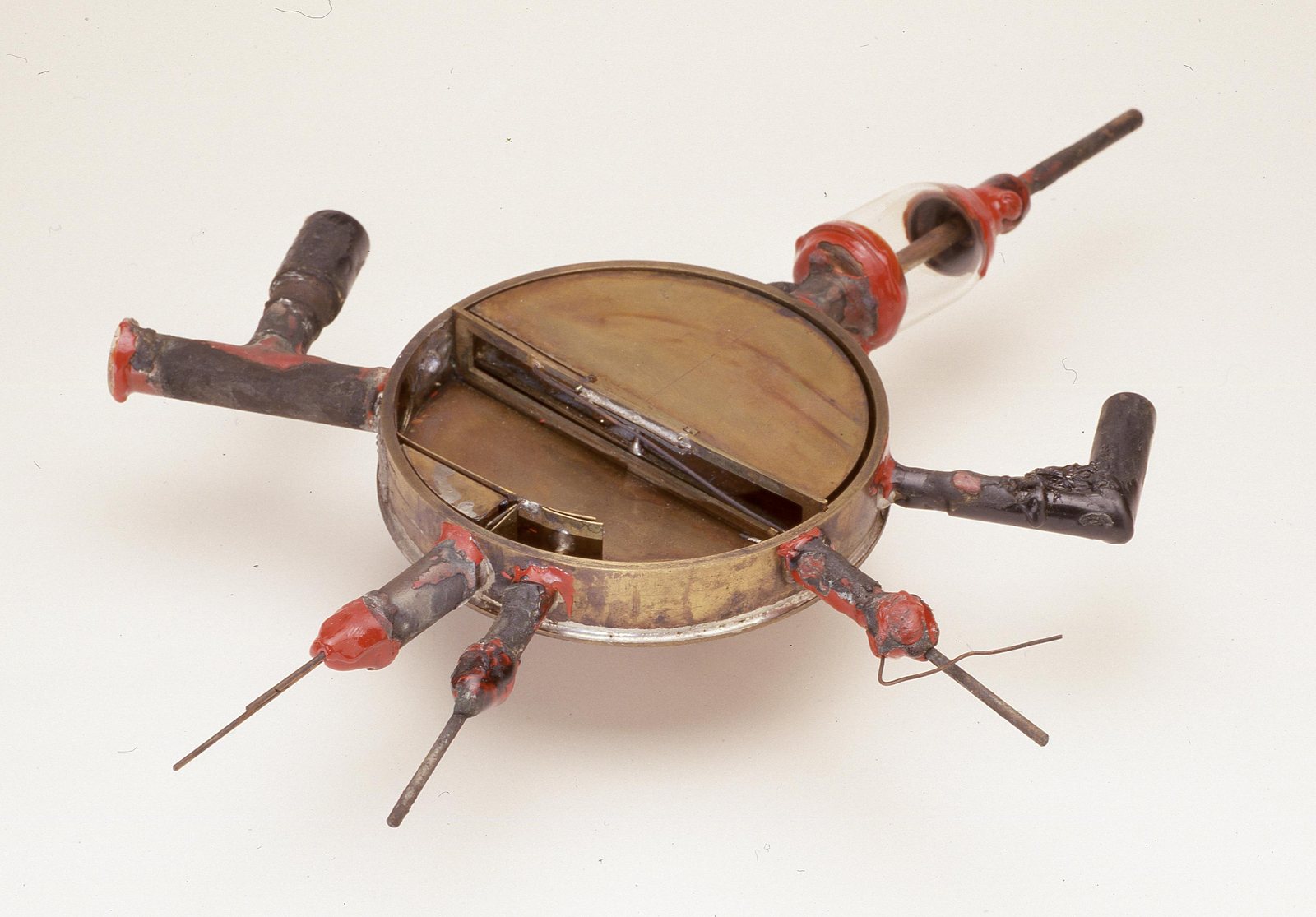
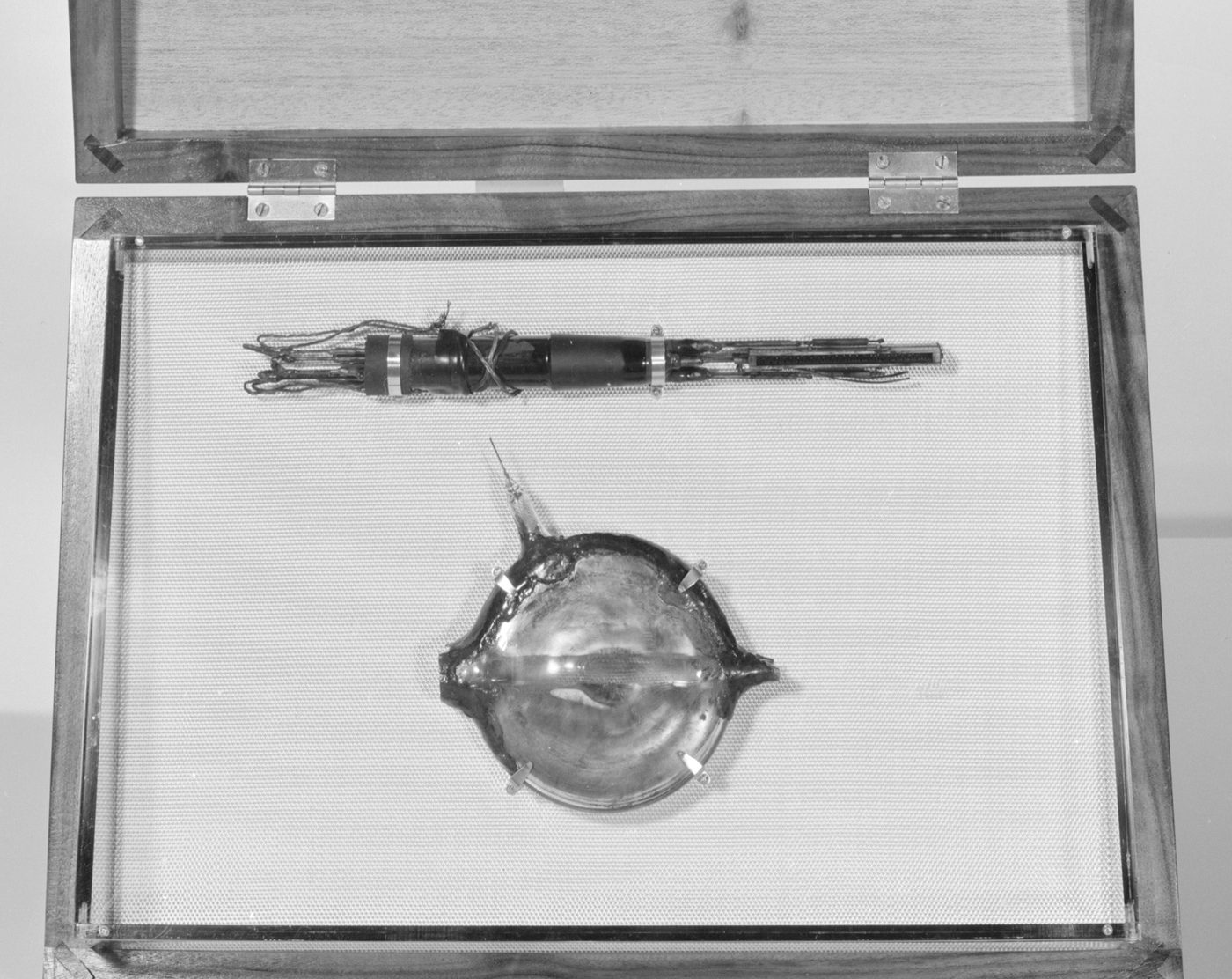
The proof fell to his graduate student M. Stanley Livingston. His thesis apparatus was a brass-and-sealing-wax chamber about 4 inches across, with one dee and a borrowed magnet. On 2 January 1931 it produced 80 keV hydrogen molecular ions with less than 1 kV on the electrode: eighty-fold voltage multiplication, exactly as the resonance principle promised (Lawrence's Nobel lecture recounts the numbers). That chamber survives. It is the first photograph below; the Smithsonian holds it, and the Lawrence Hall of Science holds a second early chamber.
1932: the MeV barrier, and a race lost
The next machine, with 11-inch poles, made history. In January 1932 it delivered 1.22 MeV protons, the first artificially accelerated particles past a million volts. The paper describing it (Lawrence & Livingston, Phys. Rev. 40, 19, 1932) is still a remarkably readable account of the whole principle, including a correct analysis of the electric and magnetic focusing that keeps the beam alive. But Berkeley was slow to put a target in the beam, and in April 1932 Cockcroft and Walton at the Cavendish split the lithium nucleus first, with a DC cascade generator of a few hundred kilovolts. The lesson, taught early: the accelerator is only half the experiment.
1933–1939: bigger poles, new elements, first patients
Lawrence's pattern was set: find a bigger magnet. A surplus 80-ton Federal Telegraph magnet became the 27-inch cyclotron in 1933, producing 20 µA of 6.3 MeV deuterons by 1936. Re-poled to 37 inches in 1937–38 it reached 8.5 MeV at 100 µA and became the workhorse of 1930s nuclear science. After the Joliot-Curies discovered artificial radioactivity in 1934, the cyclotron became a radioisotope factory: tracers for chemistry, botany, and medicine, with Lawrence's physician brother John leading the first therapeutic uses. By 1938 more isotopes had been created artificially than were known in nature (Craddock 2010).
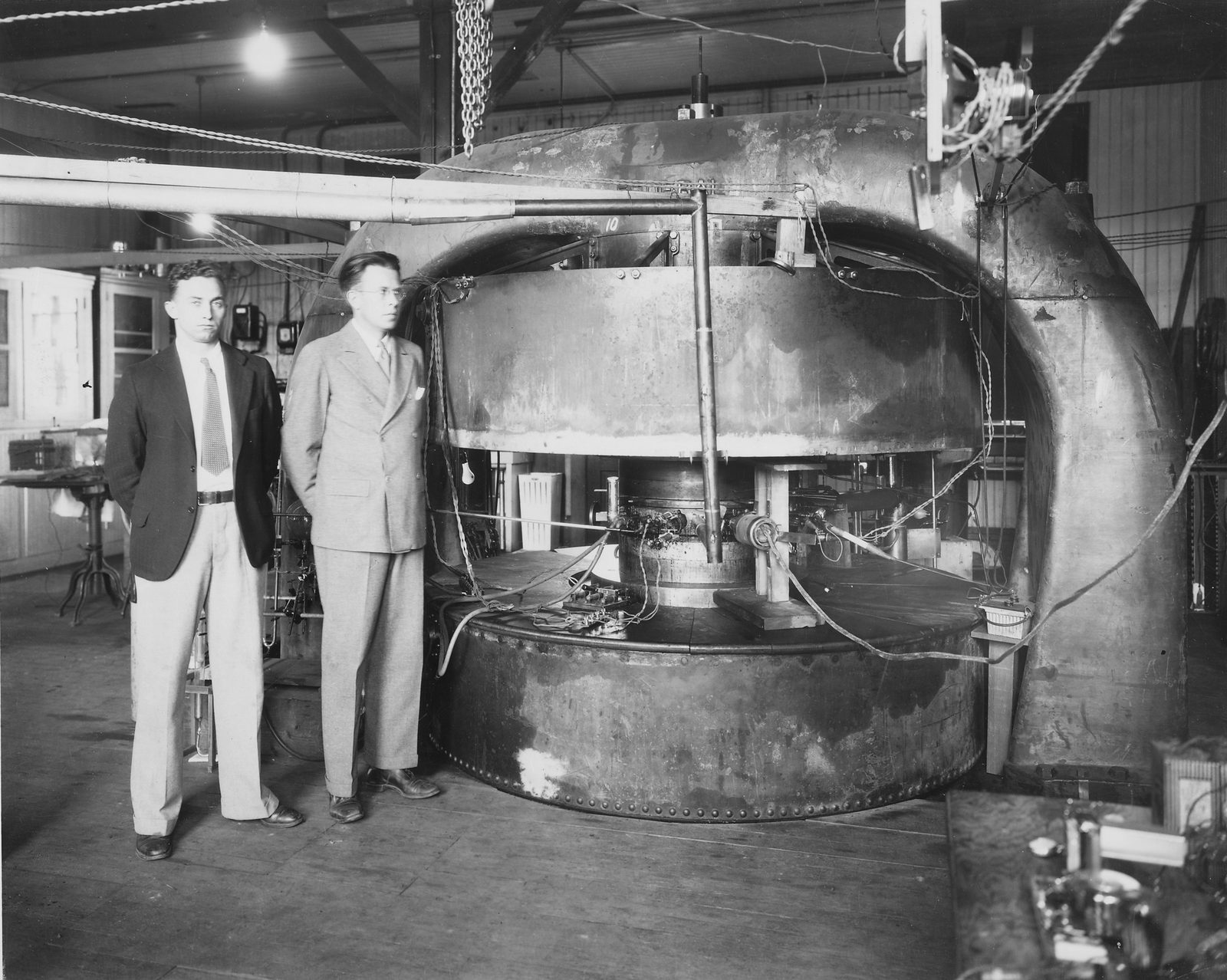
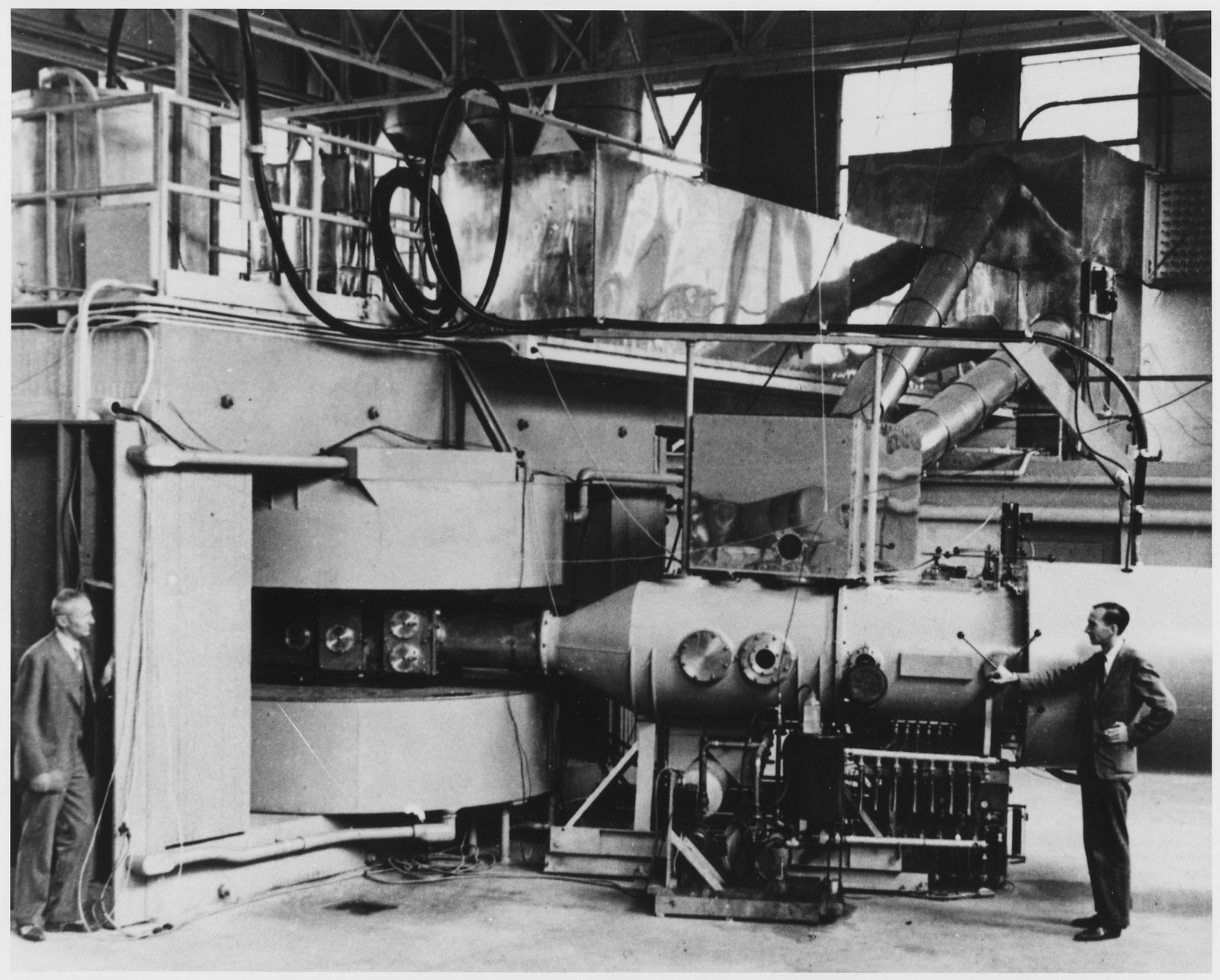
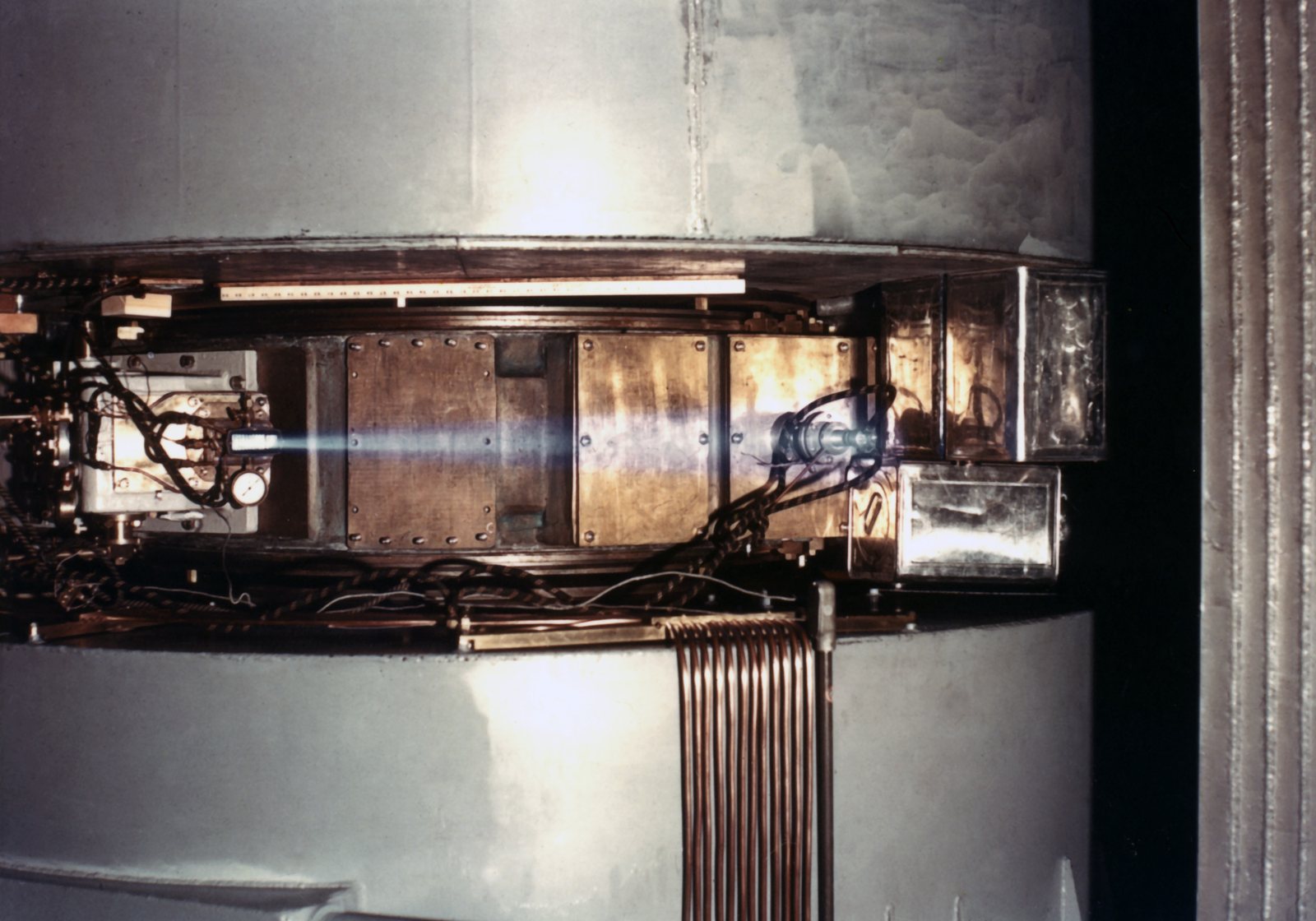
The 60-inch cyclotron at the Crocker Laboratory, explicitly built for medical and isotope work, came online in June 1939 delivering 16 MeV deuterons (its initial performance is reported in Phys. Rev. 56, 124, 1939). It went on to produce the first transuranic elements, neptunium and plutonium among six discovered there, and supported an early neutron-therapy program that treated roughly 200 patients (Craddock 2010). The design spread fast. By 1940, in Craddock's count, there were 24 cyclotrons operating in the United States, 3 in Japan, 2 each in Britain and the USSR, and one each in Denmark, France, Germany, and Sweden; the tally evidently includes machines still being built, since Germany's first cyclotron did not produce beam until 1943 (see what survives). In November 1939 Lawrence received the Nobel Prize in Physics for the invention and development of the cyclotron.
1940–1946: the wall, the war, and the synchrocyclotron
Bethe and Rose had shown in 1937 that relativity caps a fixed-frequency cyclotron around a few tens of MeV. Lawrence pressed ahead anyway. In 1940 the Rockefeller Foundation granted $1.15 million for a monster 184-inch machine, on the hope that brute dee voltage could outrun the phase slip. The war intervened, and the huge magnet spent it developing electromagnetic uranium separation. By the time physics resumed the problem had been solved outright: Veksler (1944) and McMillan (1945) independently discovered phase stability, and a 1946 test by MacKenzie and colleagues on the old 37-inch confirmed that sweeping the RF frequency could carry ions past the relativistic limit.
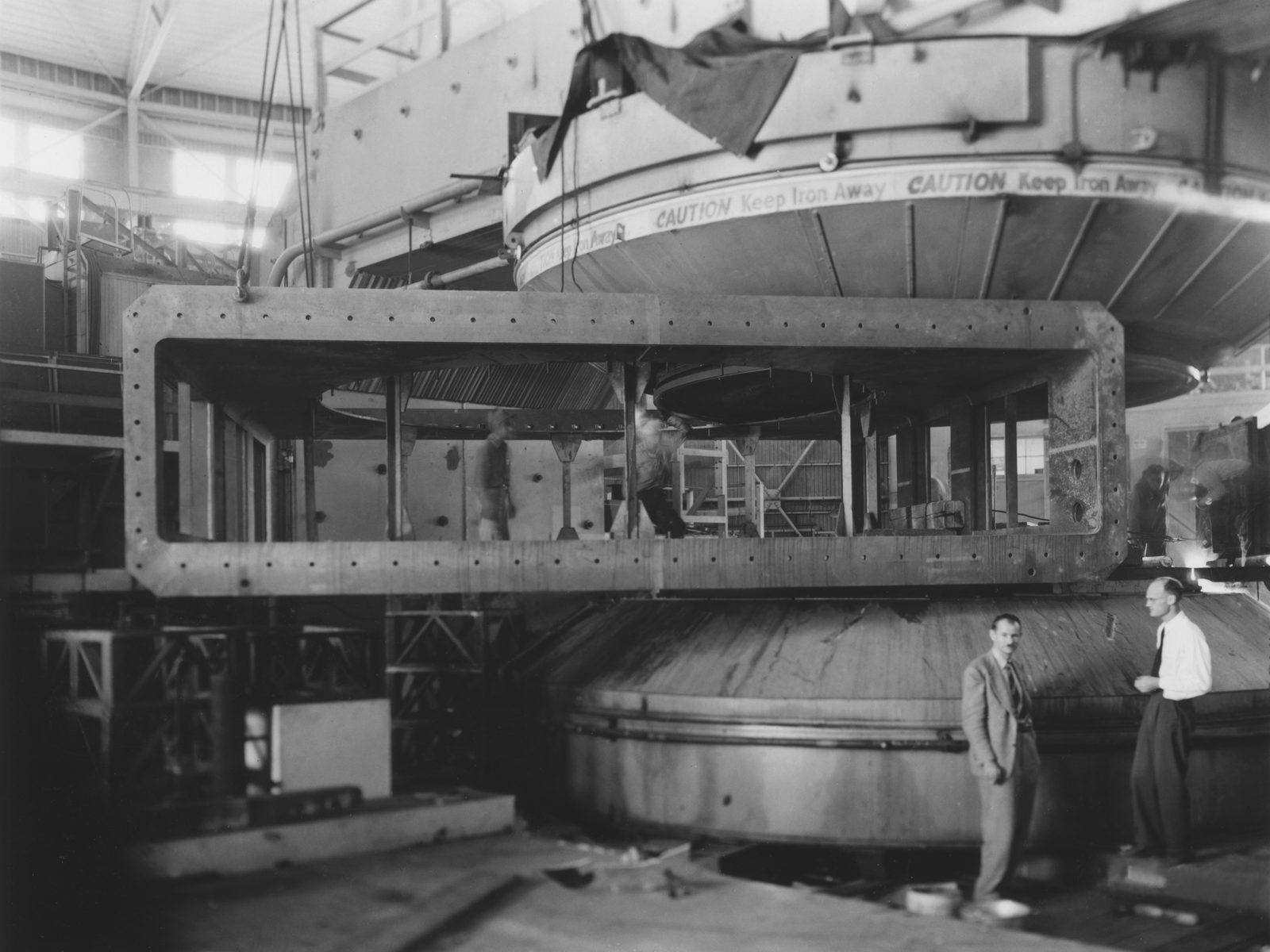
Rebuilt as a synchrocyclotron, the 184-inch (its magnet roughly 4,000 tons) produced its first beam on 1 November 1946: 190 MeV deuterons, then 380 MeV alphas and later 350 MeV protons. That is the jump across the 100 MeV line in the figure above. In 1948 it made the first artificially produced pions. Ten more large synchrocyclotrons followed worldwide between 1946 and 1954, at Harvard, Columbia, Chicago, Liverpool and elsewhere, the largest at Dubna ultimately reaching 680 MeV, and they carried meson physics until synchrotrons took over the energy frontier. Their weakness was duty cycle: a pulsed trickle of beam, at orders of magnitude less average current than a fixed-frequency machine.
The war ended the cyclotron's first international chapter by force. Japan's prewar machines, Yoshio Nishina's 26-inch at RIKEN (1937, which RIKEN describes as the first cyclotron built outside the United States), RIKEN's 60-inch, and the machines at Osaka and Kyoto, were dismantled by US occupation forces beginning 22 November 1945. RIKEN's were dumped in Tokyo Bay, an act the US War Department later conceded was a mistake (Yoshikawa & Kauffman 1994). Japan's accelerator program restarted from nothing with RIKEN's No. 3 cyclotron of 1952, which survives and appears with the other preserved machines below.
1950s–1970s: the isochronous era
The better escape from the relativistic wall had been published back in 1938, and ignored. L. H. Thomas showed that a field which rises with radius (staying isochronous at any γ) can still focus vertically if it also varies azimuthally: ridged "hill and valley" poles make the orbit scallop through alternating field sectors. The idea waited twelve years. In 1950 Richardson and colleagues at Berkeley quietly built two electron models proving it worked (the results stayed classified until 1956), and Kerst's 1955 spiral-sector suggestion strengthened the focusing further. The first sector-focused ion cyclotron ran at Delft in 1958: four sectors, 86 cm poles, 12.7 MeV protons (Heyn & Khoe; Craddock 2010). Within a few years the azimuthally-varying-field design, "AVF," was the default for every new research and isotope machine.
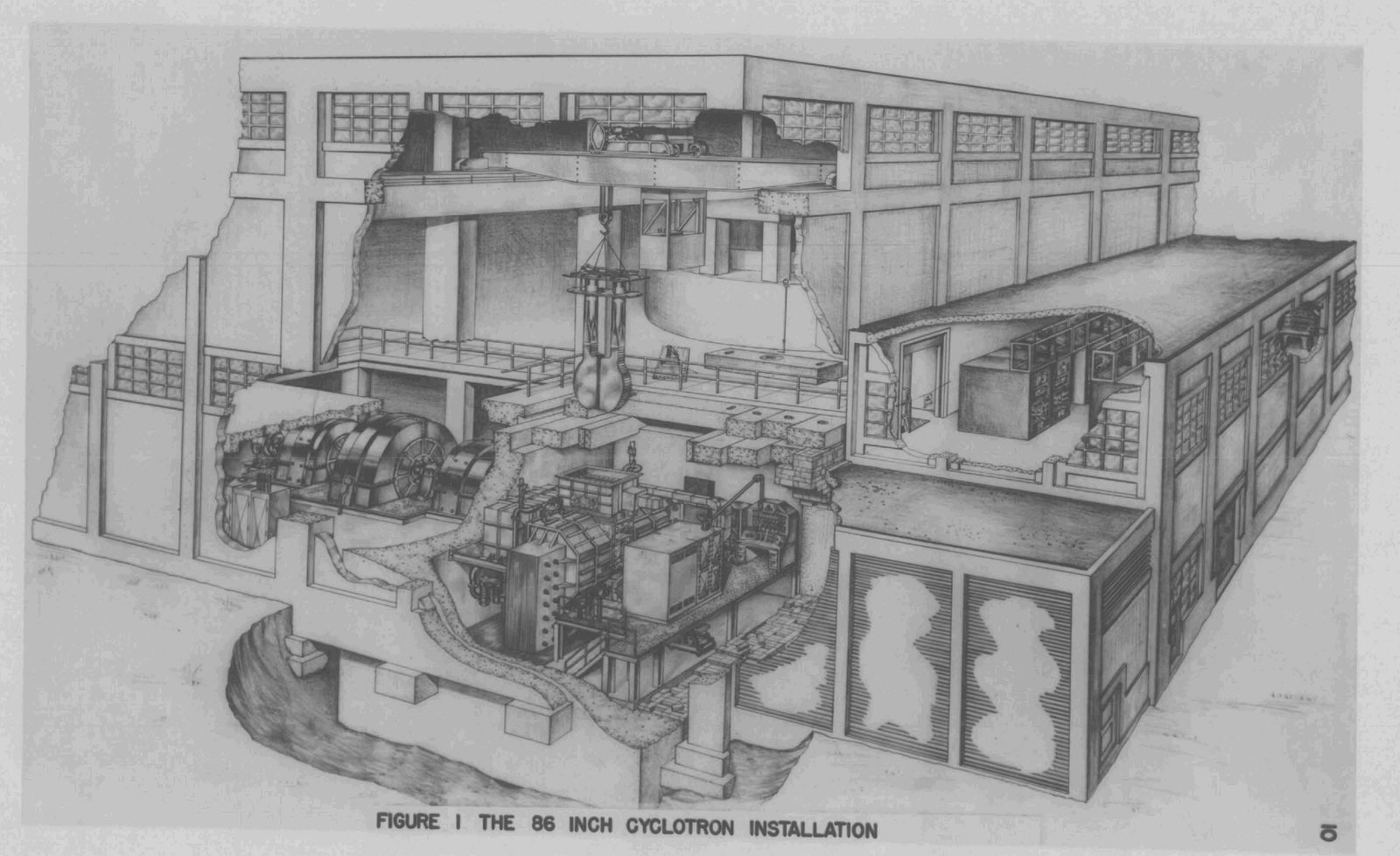
A snapshot of the world at that turning point exists, and it is in the library. Oak Ridge's 1958 directory Cyclotrons and High-Energy Accelerators — 1958 reported 140 machines worldwide, 76 of them fixed-frequency cyclotrons (56 built, 20 being built, designed, or studied) and 18 synchrocyclotrons, with a data sheet for each: field, frequency, dee voltage, energies, currents, cost. It is the best single picture of the classical era at its peak, in the very year of the first isochronous beam. For comparison, this site's census records some 1,560 machines today, the great majority of them compact isotope cyclotrons, a category that did not exist in 1958.
Isochronous machines deliver continuous beam at high current with no RF gymnastics, and they became the standard so completely that "cyclotron" now effectively means "AVF cyclotron." The era peaked with two giants. TRIUMF's six-sector H⁻ machine in Vancouver, 18 m across and described by TRIUMF as the world's largest cyclotron by diameter, produced its first 500 MeV beam on 15 December 1974 (its maximum is 520 MeV). PSI's 590 MeV separated-sector ring cyclotron in Switzerland, commissioned the same year, has since been upgraded into the most powerful proton beam of any cyclotron, above a megawatt.
The same era solved the problem every page of this history has so far stepped around: getting the beam out. Classical machines either used the beam on an internal target or pulled a fraction of it past a high-voltage deflector septum, which is lossy, hot, and activating. The alternative was to accelerate negative hydrogen ions (H⁻) and strip both electrons off with a thin foil at the extraction radius. The ion's charge flips sign, the field bends it the other way, and it leaves the machine very efficiently, at an energy set by where the foil sits; at TRIUMF, as three beams at once (Craddock 2010). The losses that remain, foil scattering and stripping on residual gas, still activate hardware, which is why the beam extraction page treats stripping as a vacuum problem as much as a magnet problem. It is one of the developments that made the compact commercial H⁻ cyclotron of the next section practical.
1982–present: superconducting and compact
Superconducting coils rewrote the size equation: several times the field of iron-limited magnets means an order of magnitude less weight for the same beam energy. Michigan State's K500, the world's first superconducting cyclotron, extracted first beam on 31 August 1982, followed in 1988 by the K1200 and by superconducting machines at Texas A&M, Catania, and Kolkata. At the research frontier, RIKEN's Superconducting Ring Cyclotron (first beam December 2006), the final booster of the RI Beam Factory, holds the record as the world's most powerful heavy-ion cyclotron, delivering beams at up to 345 MeV per nucleon.
The quieter revolution happened in hospitals. Compact isochronous machines of 10–30 MeV, sold by many vendors as turnkey isotope factories, number well over a thousand worldwide today. The IAEA maintains a database of them; the industry page follows the vendors and their machines. They produce the short-lived PET isotopes, and some SPECT isotopes, that modern imaging runs on. Superconducting compactness reached the clinic too: 230–250 MeV proton-therapy cyclotrons and synchrocyclotrons, some small enough to mount on a rotating gantry, now do work that in 1946 took a 4,000-ton magnet. Ninety-odd years on, Lawrence's spiral is a mature industrial product. The physics on the previous page is unchanged since 1932, which is the premise of the next section.
A parallel track: the amateur line, 1947–present
Look again at the chart. The frontier climbs four orders of magnitude in fifty years and then stops climbing, because the energy frontier moved to synchrotrons. Underneath it runs a second series that does not climb: machines built by students and individuals, clustered between roughly 50 keV and 1 MeV, the range the 4-inch and the 11-inch occupied in 1931–32. (The documented amateur record begins in 1947; only the later entries with a reported energy appear as points.) That is what the physics gives a builder with an iron-core magnet of a few hundred kilograms and a few kilovolts on the dees: the same numbers Lawrence and Livingston had, and the same hazards, which is why the safety page rather than this one is where a build starts.
The census on this site records 27 documented amateur and student cyclotrons, 8 of which produced a documented beam. The first is a 1947 high-school build in El Cerrito, California, reported in the press. The 1950s and 1960s saw a handful more, mostly in American high schools. Then the record falls silent for two decades, from about 1970 to 1993, and resumes with the Rutgers-Houghton-Maryland line of teaching machines in the mid-1990s, the German COLUMBUS program, the individual builds of the 2010s, and Japan's AxeLatoon student cyclotrons since 2019. The census pages carry each machine's own evidence (what it measured, how, and what it did not) and a comparison table where energies appear only for machines that reached beam. The two-decade silence is the interesting part, and the census records it without explaining it: the resonance physics of a small fixed-frequency machine did not change between 1970 and 1993, and no source in the census says what did. Where a builder's ambition should stop, and why the record stops near 1 MeV, is the subject of choosing your machine.
What survives
Most of the machines on this page were scrapped, and the frontier ones are by their nature unmovable. But a surprising number of early cyclotrons, or their chambers, or their magnets, are preserved, and several can be visited. The list below is drawn from this site's census records, which track every machine's status and institution; it holds the entries with first beam before 1960 recorded as preserved in a museum or as partial remains. Check with the institution before travelling: some are behind badge access, and whether a piece is on the floor or in storage changes. Among them: Japan's first postwar cyclotron, RIKEN's No. 3 of 1952, built after Lawrence's 1951 visit; and the first German cyclotron (Bothe and Gentner, Heidelberg, first beam December 1943), now in the Deutsches Museum.
- 1931 · Lawrence First Operating Cyclotron (4.5-inch), Smithsonian National Museum of American History (Washington, United States)
- 1932 · Lawrence 11-Inch Cyclotron, Lawrence Berkeley National Laboratory (Building 50 lobby display) (Berkeley, United States)
- 1936 · Princeton 35-Inch Cyclotron, Princeton University, Jadwin Hall (originally Palmer Physical Laboratory) (Princeton, United States) · partial remains
- 1937 · Lawrence 37-Inch Cyclotron, Lawrence Hall of Science, University of California, Berkeley (Berkeley, United States)
- 1937 · Radium Institute Cyclotron (first cyclotron in Europe), Museum of the V.G. Khlopin Radium Institute, St. Petersburg (Saint Petersburg, Russia)
- 1938 · Niels Bohr Institute Cyclotron, Danmarks Tekniske Museum, Helsingør (originally Institute for Theoretical Physics / Niels Bohr Institute, Copenhagen) (Helsingør, Denmark) · partial remains
- 1939 · Collège de France Cyclotron (Frédéric Joliot), Musée des Arts et Métiers, Paris (originally Laboratoire de Chimie nucléaire, Collège de France) (Paris, France)
- 1939 · Crocker 60-Inch Cyclotron, Crocker Nuclear Laboratory, University of California, Davis (Davis, United States) · partial remains
- 1939 · Liverpool 37-inch Cyclotron (James Chadwick), National Museums Liverpool (originally University of Liverpool) (Liverpool, United Kingdom) · partial remains
- 1943 · First German Cyclotron (Bothe/Gentner, Heidelberg), Deutsches Museum, Munich (originally Kaiser Wilhelm Institute for Medical Research, Heidelberg) (Munich, Germany)
- 1946 · Berkeley 184-Inch Synchrocyclotron, Lawrence Berkeley National Laboratory (dome now houses the Advanced Light Source) (Berkeley, United States) · partial remains
- 1949 · Harvard Cyclotron Laboratory Synchrocyclotron, Harvard University (control console at the Collection of Historical Scientific Instruments) (Cambridge, United States) · partial remains
- 1952 · RIKEN No. 3 Cyclotron (Japan's first postwar cyclotron), National Museum of Nature and Science, Tokyo (Tokyo (Ueno, Taito-ku), Japan)
- 1954 · India's First Cyclotron (Meghnad Saha's 38-inch cyclotron), University of Calcutta, Rajabazar Science College (original operator: Institute of Nuclear Physics, now Saha Institute of Nuclear Physics) (Kolkata, India) · partial remains
- 1955 · Kyoto ICR 41-inch Cyclotron, Institute for Chemical Research, Kyoto University (Uji, Japan)
- 1957 · CERN 600 MeV Synchrocyclotron (SC), CERN (Synchrocyclotron exhibition, Meyrin site) (Meyrin, Switzerland)
- 1958 · China's First Cyclotron (1.2 m Soviet-supplied cyclotron), China Institute of Atomic Energy (CIAE) (Beijing (Xinzhen, Fangshan District), China)
Sources
- E. O. Lawrence, “The Evolution of the Cyclotron,” Nobel Lecture, 11 December 1951 (nobelprize.org) — source for the Edlefsen models, the Livingston model's 80 kV with under 1 kV on the dee, and the 11-inch.
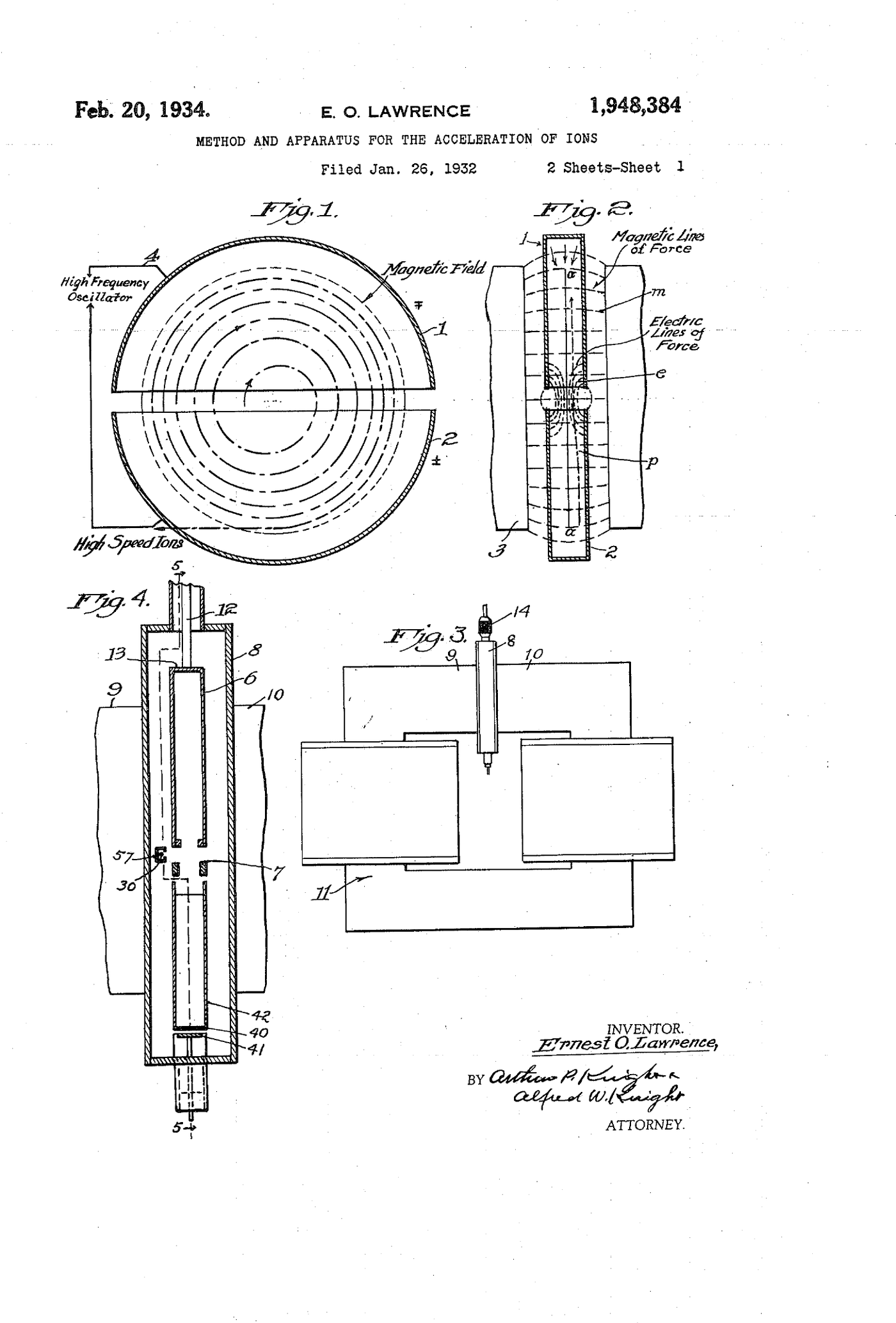
- E. O. Lawrence, US Patent 1,948,384, “Method and apparatus for the acceleration of ions,” filed 26 January 1932, granted 20 February 1934.
- E. O. Lawrence & M. S. Livingston, “The Production of High Speed Light Ions Without the Use of High Voltages,” Phys. Rev. 40, 19 (1932).
- L. Szilard, German patent application S.89288, Korpuskularstrahlrohre, filed 5 January 1929; reprinted in B. T. Feld & G. W. Szilard (eds.), The Collected Works of Leo Szilard: Scientific Papers, MIT Press, 1972, pp. 554–563. V. L. Telegdi, “Szilard as Inventor: Accelerators and More,” Physics Today 53(10), 25 (2000), is the standard account of the accelerator applications and their abandonment.
- M. S. Livingston & J. P. Blewett, Particle Accelerators, McGraw-Hill, 1962 — the standard technical history through the 1950s.
- M. K. Craddock, “Eighty Years of Cyclotrons,” Proc. CYCLOTRONS 2010, Lanzhou (JACoW, MOM1CIO02; CC BY 3.0) — source for the 1940 census, the 27/37-inch and Delft figures, the synchrocyclotron table, and stripping extraction.
- “Initial Performance of the 60-Inch Cyclotron of the William H. Crocker Radiation Laboratory,” Phys. Rev. 56, 124 (1939).
- F. T. Howard, Cyclotrons and High-Energy Accelerators — 1958, ORNL-2644 (hosted in the library) — the 1958 world directory.
- H. Yoshikawa & J. Kauffman, Science Has No National Boundaries: Harry C. Kelly and the Reconstruction of Science and Technology in Postwar Japan, MIT Press, 1994, pp. 6–9 — the destruction of the Japanese cyclotrons, 22 November 1945.
- Lawrence Berkeley National Laboratory history pages (history.lbl.gov) and the AIP History exhibit “Lawrence and the Cyclotron.”
- Lab histories: TRIUMF (first 500 MeV beam, 15 December 1974 — IEEE Milestone), MSU/FRIB (K500 first beam, 31 August 1982; K1200 first beam, 1988), RIKEN Nishina Center (SRC first beam, December 2006; 345 MeV/nucleon).
- IAEA cyclotron database and directories of medical cyclotrons.
- Preserved machines: this site's census records, each with its own sources. Amateur machines: the census, each entry cited to its builders' own publications.